
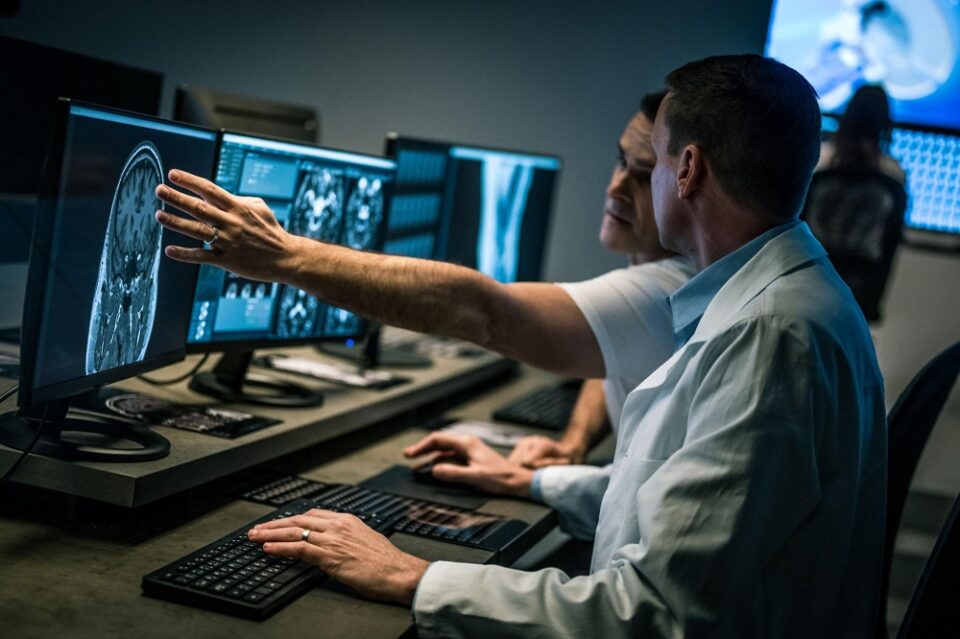
Medical imaging has always been a cornerstone of modern healthcare. From X rays to MRIs and CT scans, radiologists interpret visual data to diagnose disease, guide treatment, and monitor outcomes. Over the past decade, artificial intelligence has entered this field with measurable impact. In specific tasks, AI diagnostic tools are now matching and sometimes exceeding the performance of human radiologists.
This shift does not mean radiologists are obsolete. It does, however, signal a fundamental change in how imaging is analyzed and how clinical decisions are supported.
What Are AI Diagnostic Tools in Imaging
AI diagnostic tools use machine learning, particularly deep learning, to analyze medical images and identify patterns associated with disease.
These systems are trained on large datasets containing labeled images. For example:
- Chest X rays labeled with pneumonia or normal findings
- Mammograms labeled with cancer outcomes
- CT scans annotated for tumors or abnormalities
Companies such as Google Health and Siemens Healthineers have developed AI systems capable of interpreting imaging data with high accuracy.
How They Work
- Images are fed into neural networks
- The system extracts features automatically
- Patterns are compared against learned data
- A prediction or probability score is generated
Unlike traditional software, these systems improve as they are exposed to more data.
Why Imaging Is Ideal for AI
Medical imaging is particularly suited for AI for several reasons.
High Data Volume
Hospitals generate vast numbers of images daily. This provides rich training data for machine learning models.
Pattern Recognition
AI excels at identifying subtle patterns in visual data, including details that may be difficult for humans to detect consistently.
Standardization
Imaging formats are relatively standardized, making it easier to apply algorithms across datasets.
Repetition
Radiologists often review similar types of images repeatedly. AI systems can handle repetitive tasks without fatigue.
These factors create an environment where AI can thrive.
Where AI Is Outperforming Radiologists
AI does not outperform radiologists in every scenario, but in certain focused tasks, the evidence is strong.
1. Detection of Subtle Abnormalities
AI systems can identify minute changes in images that may be overlooked.
Examples include:
- Early-stage tumors
- Small lung nodules
- Microcalcifications in breast imaging
In some studies, AI has demonstrated higher sensitivity, meaning it detects more true positives.
2. Consistency in Interpretation
Human performance can vary due to:
- Fatigue
- Workload
- Experience level
AI provides consistent results across all cases.
3. Speed of Analysis
AI systems can process images in seconds.
- Immediate flagging of urgent cases
- Faster turnaround times
- Reduced backlog in imaging departments
Speed is critical in emergency situations such as stroke diagnosis.
4. Large-Scale Screening Programs
AI is particularly effective in screening programs where large volumes of images must be reviewed.
Examples:
- Breast cancer screening
- Lung cancer screening
- Diabetic retinopathy detection
In these settings, AI can act as a first-pass filter, identifying cases that need further review.
Evidence From Clinical Studies
Numerous studies have compared AI performance to human radiologists.
Key Findings
- AI systems can match or exceed radiologist accuracy in specific tasks
- Combining AI with human interpretation often yields the best results
- AI reduces false negatives in certain conditions
For example, in breast cancer screening, AI has shown the ability to detect cancers that were missed during initial human review.
Important Context
Performance depends on:
- Quality of training data
- Specific imaging modality
- Clinical setting
AI is not universally superior, but it is highly effective in targeted applications.
Strengths of Radiologists That AI Cannot Replace
Despite AI’s strengths, radiologists bring critical capabilities that technology cannot fully replicate.
Clinical Context Integration
Radiologists consider:
- Patient history
- Symptoms
- Lab results
AI systems typically focus only on imaging data.
Complex Decision Making
Some cases require:
- Interpretation of ambiguous findings
- Weighing multiple possibilities
- Clinical judgment beyond pattern recognition
Communication
Radiologists:
- Explain findings to physicians and patients
- Participate in treatment planning
- Provide recommendations
These human elements remain essential.
The Role of AI as an Augmentation Tool
The most effective use of AI is not replacement but augmentation.
How AI Supports Radiologists
- Highlights areas of concern
- Prioritizes urgent cases
- Reduces routine workload
Benefits of Collaboration
- Improved diagnostic accuracy
- Faster decision-making
- Reduced burnout among radiologists
This partnership model is gaining traction across healthcare systems.
Challenges and Limitations of AI Imaging Tools
Data Bias
AI models can inherit biases from training data.
- Underrepresentation of certain populations
- Variability in imaging quality
Generalization Issues
A model trained in one hospital may not perform as well in another due to:
- Different equipment
- Different patient demographics
Regulatory and Ethical Concerns
- Approval processes for medical AI tools
- Accountability for errors
- Patient privacy
Overreliance Risk
There is a risk that clinicians may rely too heavily on AI outputs without critical evaluation.
Impact on Workflow and Healthcare Systems
AI is changing how imaging departments operate.
Workflow Improvements
- Automated triage of cases
- Reduced reporting time
- Better resource allocation
Cost Implications
- Lower operational costs over time
- Increased efficiency in high-volume settings
Access to Care
AI can extend imaging capabilities to regions with limited access to specialists.
Future Directions
The development of AI in imaging is ongoing.
Emerging Trends
- Multimodal AI combining imaging with clinical data
- Real-time decision support during procedures
- Continuous learning systems that adapt over time
Long-Term Outlook
Radiologists will likely work alongside increasingly sophisticated AI tools, focusing more on complex cases and patient interaction.
What This Means for Patients
Patients stand to benefit from these advancements.
Potential Benefits
- Faster diagnoses
- Earlier detection of diseases
- More consistent results
Considerations
- Importance of human oversight
- Need for transparency in AI use
AI does not replace the physician-patient relationship but enhances the tools available for care.
Final Perspective
AI diagnostic tools are outperforming radiologists in specific, well-defined imaging tasks. They excel in speed, consistency, and detection of subtle patterns. However, they do not replace the broader expertise and judgment that radiologists provide.
The most effective model combines both strengths. AI handles data-intensive analysis, while radiologists apply clinical insight and human understanding.
This balance is shaping the future of medical imaging.
FAQ Section
1. Are AI diagnostic tools approved for clinical use
Many AI tools have received regulatory approval for specific applications, but approval varies by region and use case.
2. Do AI systems make mistakes in imaging diagnosis
Yes, AI systems can produce errors, especially if trained on limited or biased data.
3. Can AI detect all types of diseases in imaging
No, AI tools are typically designed for specific conditions and are not universal diagnostic systems.
4. How do hospitals integrate AI into radiology workflows
AI is often integrated into existing imaging software to assist with analysis and prioritization.
5. Will radiologists need new skills because of AI
Yes, radiologists are increasingly expected to understand AI tools and interpret their outputs.
6. Is AI imaging more reliable than human interpretation alone
In certain tasks, it can be more reliable, but the best results usually come from combining both.
7. How does AI impact diagnostic turnaround time
AI significantly reduces the time required to analyze images, enabling faster reporting and decision-making.
