
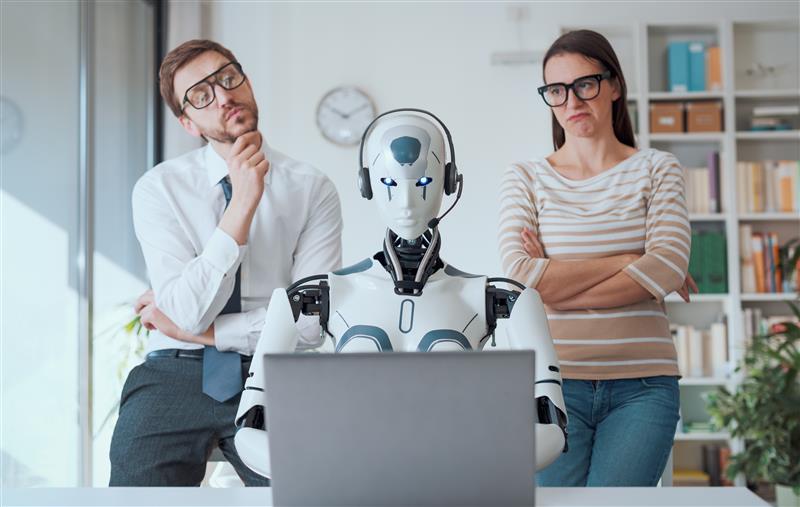
The rise of artificial intelligence in education has sparked a central question: can AI tutors match or even replace human teachers? The answer is not simple. Both approaches offer clear strengths, and both have limitations that matter in real classrooms.
This article examines what research, classroom experience, and practical use reveal about AI tutors versus human teachers. Rather than focusing on hype, the goal is to understand where each approach works best and where it falls short.
What Are AI Tutors?
AI tutors are software systems that use machine learning and data analysis to guide students through lessons, answer questions, and adapt to individual learning needs.
Examples include platforms powered by companies like OpenAI and Khan Academy, which integrate AI into personalized learning tools.
Core Features of AI Tutors
- Personalized learning paths based on student performance
- Instant feedback on answers and progress
- 24/7 availability without scheduling constraints
- Scalable instruction for large numbers of learners
These features make AI tutors particularly appealing in environments where access to human instruction is limited.
What Do Human Teachers Provide?
Human teachers bring a different set of capabilities rooted in experience, empathy, and adaptability.
Key Strengths of Human Teachers
- Emotional intelligence and understanding of student needs
- Classroom management and social guidance
- Ability to motivate and inspire
- Contextual judgment in complex situations
Teaching is not only about delivering content. It also involves shaping behavior, building confidence, and supporting development beyond academics.
Learning Outcomes: What the Evidence Shows
Research comparing AI tutors and human teachers often focuses on measurable outcomes such as test scores and retention.
AI Tutors and Academic Performance
Studies suggest that AI-driven tutoring systems can:
- Improve short-term test performance
- Help students master specific skills through repetition
- Provide targeted practice in subjects like math and science
In structured environments, AI tutors can perform as well as traditional instruction for certain types of learning tasks.
Human Teachers and Deep Learning
Human teachers tend to excel in areas such as:
- Critical thinking development
- Open-ended problem solving
- Long-term knowledge retention
These outcomes are harder to measure but are essential for real-world application.
Key Insight
AI tutors are effective for skill acquisition, while human teachers are stronger in conceptual understanding and higher-order thinking.
Personalization: Who Does It Better?
Personalization is one of the biggest selling points of AI in education.
AI Advantages
- Tracks performance in real time
- Adjusts difficulty automatically
- Identifies knowledge gaps quickly
AI systems can analyze patterns across thousands of data points, something no human can replicate at scale.
Human Advantages
- Recognizes emotional and behavioral cues
- Adapts teaching style based on personality
- Considers factors like stress, motivation, and home environment
Conclusion on Personalization
AI offers data-driven personalization, while humans provide context-aware personalization. Both are valuable, but they operate differently.
Engagement and Motivation
Keeping students engaged is one of the biggest challenges in education.
AI Tutors
- Use gamification and instant rewards
- Provide interactive content
- Maintain consistent pacing
However, engagement can drop over time if the experience feels repetitive or impersonal.
Human Teachers
- Build relationships with students
- Use storytelling and humor
- Adapt energy and tone in real time
Human interaction often creates deeper emotional engagement, which supports sustained learning.
Accessibility and Scalability
AI tutors have a clear advantage in accessibility.
Benefits of AI
- Available anytime, anywhere
- Lower cost per student at scale
- Useful in regions with teacher shortages
This makes AI a powerful tool for expanding access to education globally.
Limitations
- Requires internet access and devices
- May not support all learning styles equally
- Lacks human support for struggling learners
Human teachers, while less scalable, provide support that technology cannot fully replicate.
Feedback and Assessment
AI Tutors
- Provide immediate, consistent feedback
- Track detailed performance metrics
- Identify patterns across large datasets
Human Teachers
- Offer nuanced feedback
- Understand reasoning behind mistakes
- Adjust feedback based on student context
Balanced View
AI excels at speed and consistency, while humans excel at depth and interpretation.
Social and Emotional Learning
Education is not only academic. Social and emotional learning plays a critical role in development.
Human Teachers
- Teach communication and collaboration
- Support emotional growth
- Address behavioral challenges
AI Tutors
- Limited ability to understand emotions
- Cannot replace human relationships
- May simulate interaction but lacks genuine empathy
This is one of the clearest areas where human teachers remain essential.
Cost Considerations
AI Tutors
- Lower long-term cost once developed
- Scalable across large populations
- Minimal marginal cost per additional user
Human Teachers
- Higher ongoing costs
- Require training, salaries, and infrastructure
- Limited scalability
However, cost should not be the only factor. Quality of education matters just as much as affordability.
Limitations of AI Tutors
Despite their advantages, AI tutors have important limitations.
Key Challenges
- Lack of true understanding and reasoning
- Dependence on data quality
- Potential bias in algorithms
- Limited ability to handle ambiguous questions
AI systems are tools, not replacements for human judgment.
Limitations of Human Teachers
Human teachers also face constraints.
Common Challenges
- Limited time for individual attention
- Variability in teaching quality
- Burnout and workload pressures
- Difficulty scaling across large populations
These challenges create opportunities for AI to complement human instruction.
The Hybrid Model: Where the Evidence Points
The most effective approach is not AI versus human teachers. It is a combination of both.
How Hybrid Learning Works
- AI handles repetitive tasks and practice
- Teachers focus on discussion, mentoring, and complex topics
- Data from AI tools informs teaching strategies
Benefits of Integration
- Improved efficiency
- Better personalization
- Enhanced learning outcomes
This model leverages the strengths of both systems while minimizing their weaknesses.
Real-World Applications
In Classrooms
- AI supports homework and practice
- Teachers lead instruction and discussion
In Remote Learning
- AI provides continuous support
- Teachers offer scheduled guidance
In Professional Education
- AI delivers skill-based training
- Human instructors handle advanced topics
Final Verdict
AI tutors are not replacing human teachers, but they are reshaping how education works.
What the Evidence Suggests
- AI is effective for structured, repetitive learning
- Human teachers are essential for complex, social, and emotional development
- The best outcomes come from combining both
The future of education is not about choosing one over the other. It is about using each where it performs best.
FAQ Section
1. Can AI tutors fully replace teachers in the future
Current evidence suggests they cannot fully replace human teachers, especially in areas requiring emotional and social interaction.
2. Are AI tutors suitable for young children
They can be useful for basic skills, but young learners benefit significantly from human guidance and interaction.
3. Do AI tutors adapt to different learning speeds
Yes, most AI systems adjust difficulty and pacing based on student performance.
4. Are AI tutors reliable for all subjects
They are most effective in structured subjects like math and science, but less effective in subjects requiring interpretation and discussion.
5. How do teachers use AI in classrooms today
Teachers use AI tools for grading, practice exercises, and tracking student progress.
6. Is learning with AI less effective than traditional teaching
It depends on the context. AI can match traditional methods in some areas but not all.
7. What skills do teachers need in an AI-driven education system
Teachers need to understand technology, interpret data insights, and focus more on mentoring and critical thinking development.
